
Cinematic Church Video: Why 3-Point Lighting is the Secret to Professional Livestreams
![[HERO] Cinematic Church Video: Why 3-Point Lighting is the Secret to Professional Livestreams](https://site-2743970.mozfiles.com/files/2743970/medium/_HERO__Cinematic_Church_Video-_Why_3-Point_Lighting_is_the_Secret_to_Professional_Livestreams.jpg)
So your church livestream looks...flat. Your pastor is well-lit, but there's no depth, no dimension, no visual interest. The image looks like a mugshot instead of a Sunday morning message. You've upgraded your camera, tweaked your audio, but the video still doesn't look cinematic.
Here's the problem: You're using straight-on lighting.
Most churches light their stage like they're illuminating a parking lot, bright, even, and completely flat. It gets the job done for the people in the room, but on camera? It kills the depth that makes video look professional. The good news? There's a simple fix, and it's been the secret weapon of filmmakers and TV producers for decades.
It's called 3-point lighting, and it's about to transform how your church looks online.
Let's break it down.
7 Mistakes You're Making with Moving Head Lights (And How Volunteers Can Fix Them)
So you finally got budget approval for moving head lights. You're excited. Your pastor is excited. Then you hang them, program a few scenes, and suddenly realize... they're not doing what you expected. Maybe the beams are pointing at the back wall during worship. Maybe your Saturday volunteer spent three hours trying to figure out why nothing responds. Or maybe your livestream looks like a disco nightmare instead of a professional broadcast.
Here's the thing: moving head lights are incredible tools, but they're also really easy to mess up if you don't know the common pitfalls. And when you're working with volunteers who rotate every few weeks? Those mistakes multiply fast.
Let's walk through the seven biggest mistakes church tech teams make with moving heads, and more importantly, how to fix them without needing an engineering degree.
The Church Tech Director's Guide to Upgrading Stage Lighting Without Blowing Your Budget
So you've been handed the church lighting budget for the year, looked at your wish list, and immediately felt that sinking feeling. The pastor wants "something more dynamic" for worship. Your livestream viewers keep complaining about flickering lights on camera. And somehow, you're supposed to make it all happen without spending what a small car costs.
Here's the good news: upgrading your church stage lighting doesn't have to drain the entire tech budget. With some strategic planning and smart priorities, you can create a setup that looks professional, works for your volunteers, and actually improves your broadcast quality, all without the sticker shock.
Let's break down how to do this right.
The Secret to Flicker-Free Livestreams: Why Tunable Lighting is a Game Changer for Churches
You've poured your heart into creating meaningful worship experiences. Your team rehearses, your pastor prepares, and your production crew works tirelessly to share those moments online. But when you watch the
livestream back, there's something distracting: flickering lights, weird scan lines rolling across the image, or washed-out skin tones that make everyone look like they're broadcasting from a dimly lit basement.
Sound familiar?
Moving Heads vs. Static Lights: Which Upgrade Actually Makes Sense for Your Church? (Revised)
If you've spent any time researching lighting upgrades for your church, you've probably found yourself staring at product pages wondering: Do we really need moving heads, or are we just chasing the cool factor?
It's a fair question. Moving head fixtures look incredible, there's no denying that. But they also come with a higher price tag, more complexity, and a steeper learning curve. Meanwhile, static lights have been the backbone of church lighting for decades, offering reliability and simplicity that's hard to beat.
So which upgrade actually makes sense for your church? Let's break it down.
Ellipsoidal vs. Fresnel: The Simple Guide to Choosing Your Church Front Wash
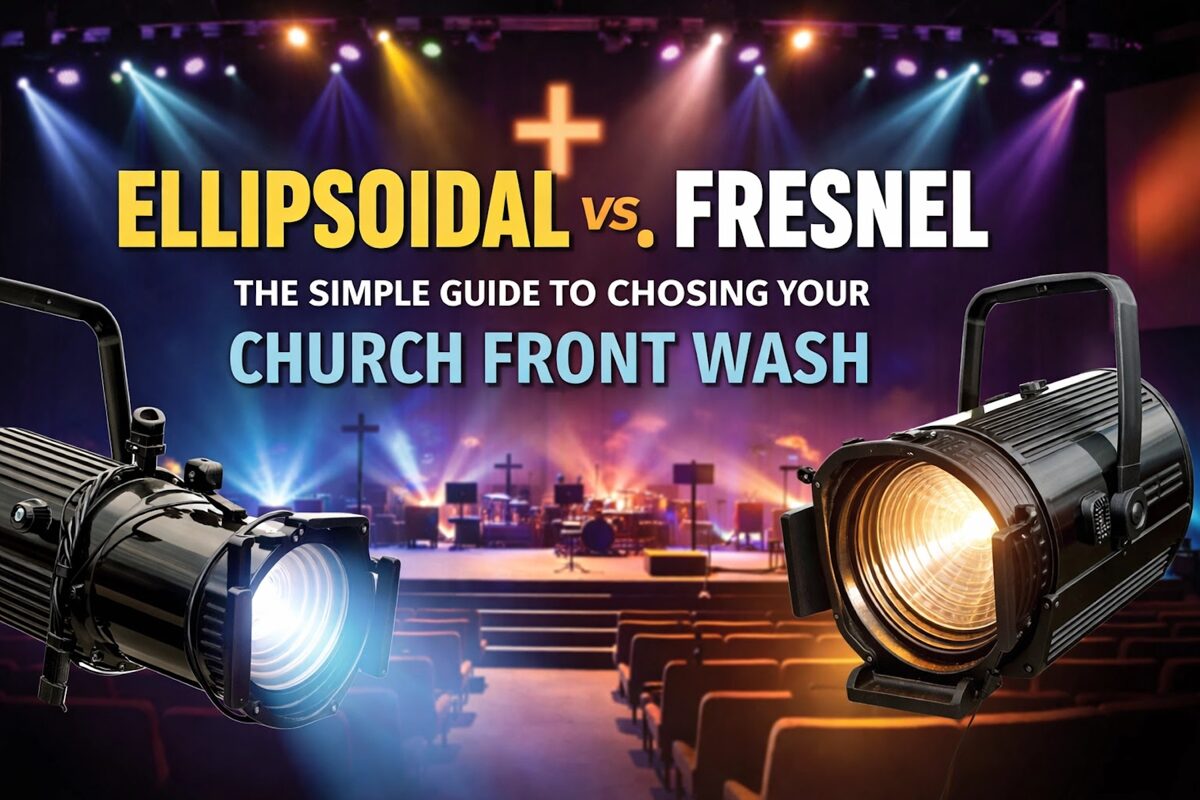
So you're trying to figure out the best way to light your stage for Sunday mornings. You've probably heard terms like "Fresnel" and "Ellipsoidal" thrown around, and honestly? It can feel like learning a new language.
Here's the good news: it's not as complicated as it sounds. By the end of this guide, you'll know exactly which fixture does what, when to use each one, and how to make your pastor (and your livestream viewers) look amazing.
Let's break it down.