
LED Stage Lights for Theaters: 10 Things to Know Before Upgrading Your School or Community Stage

So you’re trying to upgrade the lighting in a school auditorium, community theater, or church performance space: and suddenly you’re looking at CRI, TLCI, beam angles, DMX, PWM, wattage, and rigging limits.
Honestly? It can feel like learning a new language.
The good news is that choosing LED stage lights for a theater doesn’t have to be complicated. You just need to evaluate the fixtures against the realities of your space: actors’ faces, quiet scenes, slow fades, livestream cameras, older battens, rotating volunteers, and a budget that probably isn’t unlimited.
Theater lighting is different from simply making a room brighter. Your lights need to support storytelling, atmosphere, color, movement, and visibility: often at the same time. And while LED can reduce power use and maintenance, the wrong fixtures can create new problems.
Here’s a practical 10-point checklist to help you choose with confidence. Let’s break it down.
1. Will skin tones and costumes look natural?
A bright fixture isn’t automatically a good theater fixture. If the light has poor color quality, an actor’s face may look gray, greenish, or strangely orange: even when the stage appears bright to the audience.
CRI, or Color Rendering Index, measures how accurately a light reveals colors compared with a reference light source. For theatrical work, look for CRI 90 or higher when possible.
You may also see TLCI, or Television Lighting Consistency Index. TLCI focuses more specifically on how light performs on camera, which matters if your theater records performances or runs a livestream.
The key takeaway: prioritize accurate color, not just brightness.
Look for:
- CRI of 90 or higher
- TLCI of 90 or higher for video-friendly performance
- Strong red rendering, often listed as R9
- Published test data rather than vague “studio quality” claims
- Consistent color from one fixture to the next
Color temperature matters, too. It’s measured in Kelvin (K) and describes whether white light appears warm or cool. A 3000K fixture looks warmer and more amber, while a 5600K fixture looks cooler and more blue. Tunable fixtures can give you flexibility for different productions.
For a traditional front wash, neutral or warm-white options are often more flattering than extremely cool daylight. But there isn’t one universal answer: your scenery, costumes, camera setup, and artistic style all matter.
2. Are the lights truly flicker-free for video?
A fixture can look perfectly steady to your eyes and still flicker on a camera.
That happens because many LEDs use PWM, or Pulse Width Modulation. In plain English, the fixture rapidly switches the LED on and off to control brightness. If that rate conflicts with a camera’s shutter speed, the image may show rolling bands, pulsing, or strobing.
That’s a problem for school productions, recorded plays, audition videos, and livestreams.
Flicker-free LED lights protect the quality of your video: not just the experience inside the theater.
Before buying, ask:
- Is the fixture tested for flicker-free camera operation?
- Does it offer a selectable high-frequency PWM mode?
- Does performance remain stable at low intensity?
- Can the manufacturer provide test information instead of just using the words “flicker-free”?
A decade ago, video flicker might not have mattered much for a small theater. Today, nearly every audience member carries a camera. It’s worth planning for.
3. Does the beam angle fit the job?
A beam angle describes how wide the light spreads. A narrow beam concentrates light in a smaller area, while a wide beam covers more stage.
Think of it like paintbrushes: a narrow brush gives you detail, while a wide brush covers the background quickly. Theater lighting needs both.
For example:
- Front wash: Often benefits from controlled, medium-width beams aimed at acting areas
- Downlighting: Usually needs even coverage from overhead positions
- Side light: May require tighter control to avoid spilling into the audience
- Backlight and cyc lighting: Often benefit from wider, more even coverage
- Specials and gobos: Usually need profile or ellipsoidal fixtures with precise optics
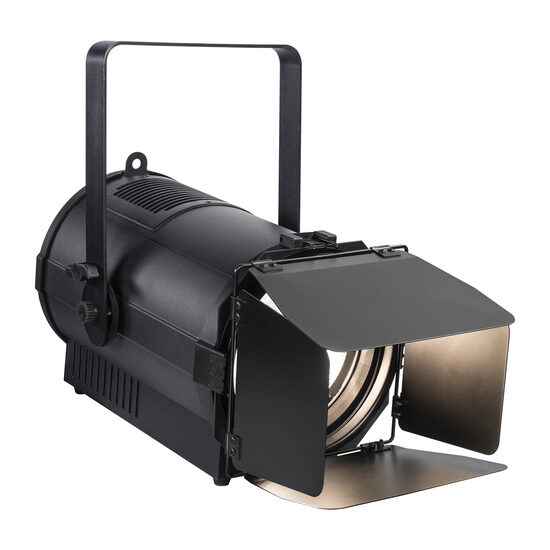
A Fresnel (pronounced “fruh-NEL”) produces a soft-edged beam that’s forgiving when aiming and refocusing. It’s often a practical choice for general washes and facial clarity. An ellipsoidal, sometimes called a profile or Leko, provides more precise beam shaping and can project gobos: metal or glass patterns used to create texture.
SM Lights offers theater-ready options such as the Pioneer Fresnel Series and Profile LED Ellipsoidals.
4. Will the dimming look smooth during theatrical fades?
Theater productions rarely use lighting only at full power or blackout. A scene may fade slowly over 20 seconds. A sunrise may build almost imperceptibly. A dramatic moment may require a clean crossfade between two looks.
That’s where dimming quality matters.
Good LED dimming should feel intentional, not electronic.
Look for:
- 16-bit dimming, which provides finer intensity control
- Smooth fades without visible stepping
- A theater-friendly dimming curve
- Minimal color shift as the fixture dims
- Consistent behavior across multiple fixtures
A dimming curve controls how quickly the light appears to change as you move a fader. Some fixtures offer an incandescent-style curve, which helps LED fixtures respond more like traditional tungsten lights.
And test low-level dimming before you commit. A fixture that looks impressive at 100% may jump, flicker, or change color at 5%.
5. Are the fixtures quiet enough for dramatic scenes?
A loud cooling fan can ruin a quiet monologue, acoustic performance, or recording.
LED fixtures still produce heat, so they need a way to manage it. Some use fans; others use passive or convection cooling, which allows heat to dissipate without moving parts.
For fixtures near microphones or the audience, noise should be part of the specification: not an afterthought.
Ask about:
- Fan-free or convection-cooled operation
- Silent modes
- Fan noise ratings
- Whether quiet mode reduces output
- The sound of moving lights during pan and tilt
Fan-free fixtures can be especially attractive in small theaters where the lighting positions are close to the audience. If a fixture does use a fan, place it thoughtfully and confirm the noise level in the actual room.
6. Can your volunteers operate the DMX system?
DMX, short for Digital Multiplex, is the control language used by many stage lighting fixtures. It allows a lighting console to control intensity, color, movement, zoom, and other fixture functions.
The technology is powerful. It can also be intimidating.
Your team shouldn’t need a professional lighting designer on-site every night just to bring up a front wash.
The best control system is one your actual operators can learn and use confidently.
Consider:
- Clear fixture profiles
- Simple patching and addressing
- Presets for common looks
- Faders for essential washes
- Playback buttons for scenes and transitions
- RDM, or Remote Device Management, for easier fixture discovery and configuration
- A system that can grow with your theater
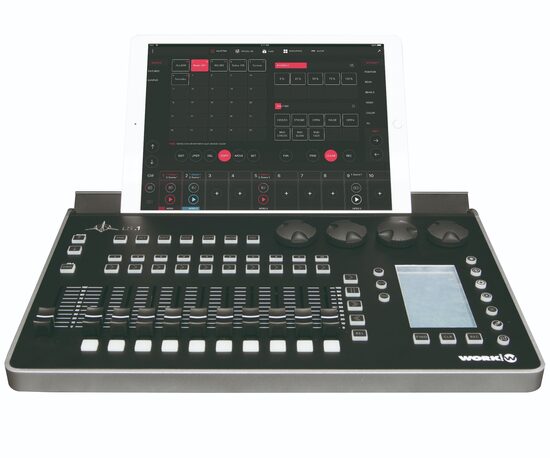
For volunteer-based teams, a practical console or control surface can make a bigger difference than adding more fixtures. SM Lights offers control options including the LS-1, LS-Core, and ChamSys QuickQ consoles.
7. Does the budget include power and maintenance?
LED fixtures can cost more upfront than basic conventional fixtures. That’s a fair concern: especially for a school or community theater working through grants, seasonal budgets, or fundraising.
But the purchase price is only one part of the calculation.
Compare:
- Fixture cost
- Required accessories and clamps
- New cabling or DMX distribution
- Console or control upgrades
- Electrical capacity
- Expected power consumption
- Lamp replacement and maintenance
- Warranty and service availability
LED fixtures typically use less power than traditional tungsten fixtures, which may reduce electrical load and operating costs. They also eliminate many lamp changes. But savings vary by fixture, usage schedule, utility rates, and how your existing system is configured.
Ask for a total cost of ownership: not just a unit price.
A cheaper fixture that fails during tech week, has inconsistent color, or requires difficult repairs may not be cheaper in practice.
8. Will the fixtures work with your existing stage positions?
Before ordering, measure your throw distances, trim heights, available circuits, connector types, and mounting positions.
A throw distance is the distance from the fixture to the area you want to light. A light that works beautifully from a short front-of-house position may not have enough intensity or the right beam angle for a high catwalk.
Your theater may need a combination of:
- Fresnels for soft front wash
- Profiles for specials and gobo projection
- PAR-style fixtures for general color wash
- Cyc or flood fixtures for backdrops
- Moving lights for dynamic productions
Review the actual photometric data: such as lux at distance or beam charts: rather than relying only on wattage. Wattage tells you how much power a fixture consumes. It doesn’t tell you exactly how much useful light reaches the stage.
9. Can your older battens and rigging support them?
Many school and community theaters operate in older buildings. Their battens, electrics, catwalks, and mounting hardware may have limits that weren’t designed around modern moving lights.
A batten is a pipe or bar used to hang stage equipment. Before adding fixtures, verify:
- The fixture’s weight
- Batten and rigging load limits
- Clamp compatibility
- Safety cable attachment points
- Available clearance
- Power and data cable routing
- Venue inspection and safety requirements
Don’t assume that “LED” means “lightweight.” Some LED profiles and moving fixtures are substantial.
Have the rigging and electrical side reviewed by a qualified professional before installation. The right fixture still needs to be installed safely.
10. Who will answer when something goes wrong mid-run?
This may be the most overlooked part of buying stage lighting.
When a fixture fails during a dress rehearsal, you don’t need a generic email address and a manual written for someone three time zones away. You need practical help from someone who understands your console, your stage, and the pressure of a live production.
SM Lights provides US-based support from real lighting professionals with more than 17 years of AVL experience. As the lighting arm of Shepherd Multimedia, the team brings nearly two decades of hands-on installation experience: not just product knowledge.
Support matters before the sale, during installation, and when the show must go on.
Quick comparison checklist
| What to evaluate | Practical target or question |
|---|---|
| Color quality | CRI 90+; TLCI 90+ for camera use |
| Flicker | Tested flicker-free performance at multiple dimming levels |
| Beam | Does the angle match your throw distance and lighting position? |
| Dimming | Smooth low-level fades and theater-friendly curves |
| Noise | Fan-free or quiet operation near microphones and audiences |
| Control | DMX compatibility with volunteer-friendly presets |
| Budget | Compare purchase price, power, lamps, repairs, and support |
| Compatibility | Does it work with your console, cables, and electrical system? |
| Rigging | Confirm weight, clamps, safety points, and batten capacity |
| Support | Can you reach a knowledgeable US-based lighting professional? |
Ready to plan your theater lighting upgrade?
You don’t have to figure out your stage lighting fixtures alone: or choose between generic budget gear and an unnecessarily complicated system.
SM Lights can help you evaluate your room, throw distances, existing infrastructure, production needs, and volunteer skill level. Whether you need a better front wash, quieter fixtures for theatrical performances, reliable flicker-free LED lights for livestreaming, or a complete theater lighting package, we’re here to help.
Explore the SM Lights stage lighting collection, review control options, or contact our team for free design help.
Tell us about your stage, and we’ll help you build a lighting system that’s professional, practical, and ready for opening night.