
7 Mistakes You're Making with Church Stage Lighting (And How to Fix Them Before Sunday)
![[HERO] 7 Mistakes You're Making with Church Stage Lighting (And How to Fix Them Before Sunday)](https://cdn.marblism.com/Ydj8Nn-C0k1.webp)
So you've finally got some decent stage lighting installed, your pastor looks great in person, the worship team is visible from the back row... and then you watch the livestream playback. Flat faces. Washed-out colors. Zero depth. Your stage looks like a high school yearbook photo from 1987.
You're not alone. Most churches make the same handful of lighting mistakes: and honestly? They're way easier to fix than you think. Let's walk through the seven biggest issues we see (and how to knock them out before Sunday morning).
Mistake #1: Using Flat, Straight-On Lighting (And Wondering Why Your Video Looks Boring)
Here's the big one. If all your lights are mounted directly in front of your stage, pointing straight at your pastor's face, you're creating two-dimensional lighting. It looks fine to the human eye in the room, but on camera? Flat. Lifeless. Zero dimension.
The fix? 3-point lighting: the same technique Hollywood uses to make actors look cinematic.
What Is 3-Point Lighting?
It's a simple lighting triangle that creates depth, dimension, and separation:
- Key Light: Your main light source, positioned at about 45 degrees to one side of the subject. This is your primary illumination: it defines the face and creates natural shadows.
- Fill Light: Positioned on the opposite side, softer and less intense (about 40–60% of your key light). This fills in the harsh shadows created by the key light without eliminating them completely.
- Back Light (Rim Light): Positioned behind and slightly above the subject, aimed at the back of the head and shoulders. This separates the person from the background and creates that professional "glow" around the edges.
When you combine all three, faces suddenly have dimension. Cheekbones catch light. Shoulders separate from the backdrop. Your pastor doesn't look like a cardboard cutout anymore.
How to set it up in your church:
You don't need a dedicated three-light rig for every person on stage (that's overkill). Instead, think in layers:
- Use your front wash fixtures as your key light (positioned at 45-degree angles from stage left and right, not dead center).
- Add side fill from stage wings or balcony positions to soften shadows.
- Use backlighting from truss-mounted fixtures or moving lights like the Hero 400BSW to create separation.
The difference is night and day on camera: and your livestream audience will actually see facial expressions instead of flat, featureless heads.
Mistake #2: Blasting Everything at 100% Intensity
If your lighting console looks like someone turned every fader to full blast, you're doing it wrong. Cranking front wash lights to 100% washes out faces on camera, eliminates shadow detail, and makes everyone look like they're being interrogated.
The sweet spot? 60–70% intensity for most front wash fixtures.
This gives you natural-looking illumination without the harsh, overexposed look. Your camera's sensor will thank you: and so will anyone watching the livestream who doesn't want to squint at glowing white blobs.
Pro tip: If you're using SM Lights fixtures with flicker-free technology, you can dim them down without worrying about strobing effects on camera. Older fixtures? Not so much. Dimming cheap LEDs often creates visible flicker in video: another reason to upgrade.
Mistake #3: Dark Patches and Uneven Coverage
Walk around your sanctuary during a service. Notice how the drummer is perfectly lit, but your acoustic guitarist on stage left is standing in a shadow cave? Uneven lighting makes parts of your stage unusable: and creates distracting hot spots and dark zones on camera.
The Fix:
- Position fixtures symmetrically to create overlapping coverage zones. No one fixture should be responsible for lighting an entire area.
- Test your coverage during rehearsal by having someone walk across the stage. If they disappear into shadow at any point, adjust your angles.
- For smaller churches, prioritize key zones first: pulpit, lead vocalist, and main musician positions. You can expand coverage as budget allows, but make sure your most important spots are nailed down.
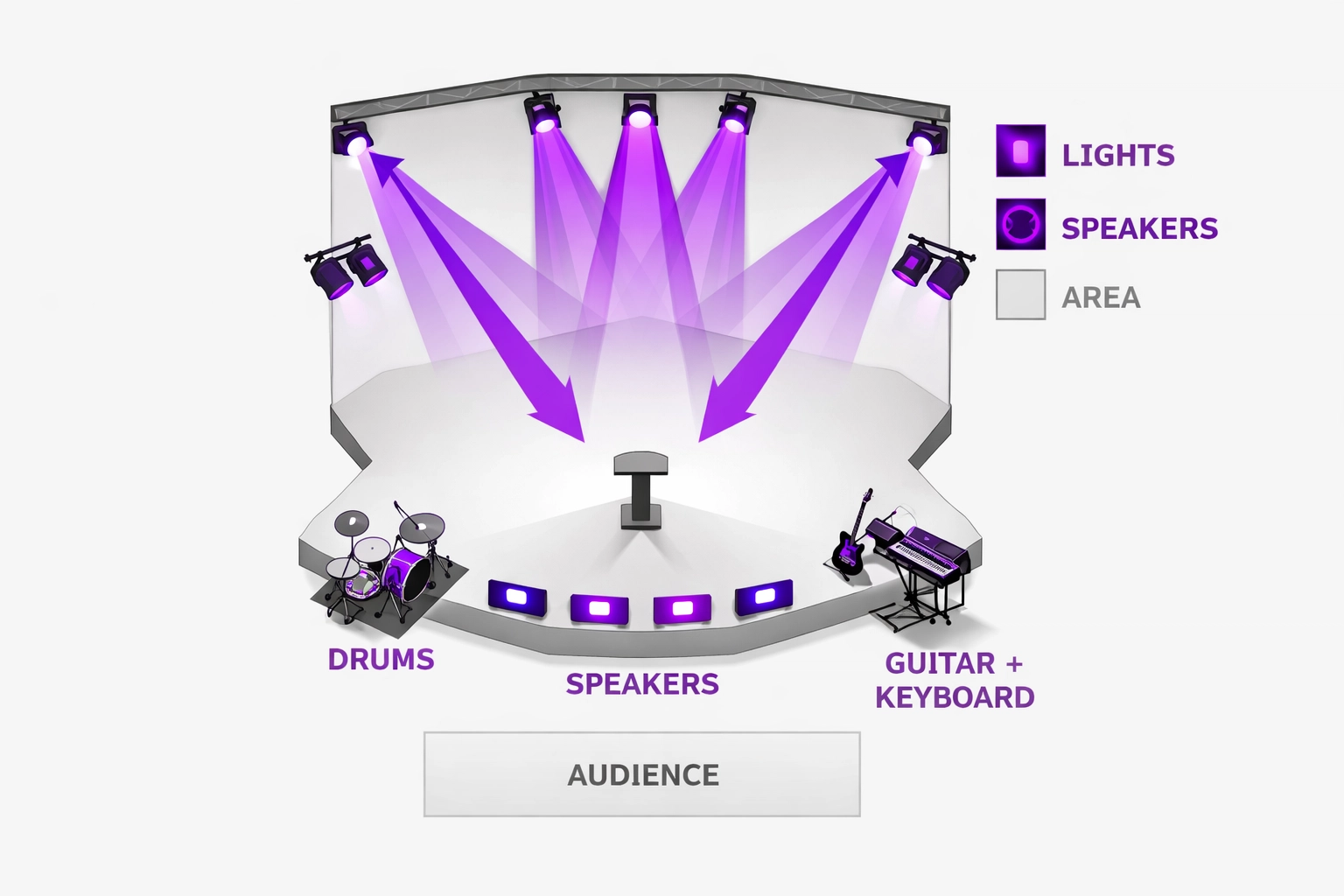
Your stage doesn't need to be evenly lit like a grocery store: but the areas that matter (faces, instruments, key speaking positions) should have consistent, even illumination.
Mistake #4: Mismatched Color Temperatures (AKA "The Frankenstein Stage")
If you're mixing old tungsten bulbs with new LED fixtures, or you grabbed random LED pars from three different manufacturers, your stage probably looks like a patchwork quilt. One side glows warm and orange, the other side is cool and blue-white. Your video feed looks like a science experiment.
The Fix:
Standardize your color temperature across all fixtures. For church environments, 3500K–4500K is the ideal range: it's natural-looking on skin tones and balances well with most projection screens and video walls.
If you've already got a mix of fixtures and can't replace everything at once:
- Group similar fixtures together by zone (all the warm lights stage left, all the cool lights stage right).
- Use your lighting console to color-correct LEDs so they match older tungsten fixtures.
- Plan your next upgrade to replace the most mismatched fixtures first.
Consistency matters more than perfection. A stage lit entirely with slightly warm light looks better than one half warm, half cool.
Mistake #5: Ignoring the Congregation (And Creating a Spotlight Show)
Your stage is blazing bright, your worship team looks amazing... and your congregation is sitting in near-total darkness. This creates emotional disconnect. Worship isn't a performance: it's a shared experience. When the audience feels invisible, they feel disconnected.
The Fix:
Keep some ambient lighting on in the congregation area, even if it's dimmed to 30–40%. You want enough light for people to see their Bibles, find their seats, and feel like part of the experience: without competing with the stage lighting.
Bonus: If you're livestreaming and occasionally cut to audience shots, you don't want to see a black void. A little fill light in the house makes those wide shots look intentional instead of accidental.
Mistake #6: Glare, Reflections, and the Dreaded "Shiny Cymbal Effect"
Ever notice how your drummer's cymbals create blinding reflections? Or how your pastor's glasses turn into glowing white rectangles on camera? Glare from stage lights bouncing off reflective surfaces kills your video quality fast.
The Fix:
- Adjust fixture angles to avoid direct reflections into the camera lens or audience sightlines. Sometimes a 10-degree shift solves the problem.
- Add barn doors or honeycomb filters to fixtures that are spilling light onto reflective surfaces (cymbals, glass podiums, shiny instrument finishes).
- Use indirect lighting techniques where possible: bounce light off walls or ceilings instead of pointing fixtures directly at reflective objects.
If your camera operator is constantly fighting lens flare, your light angles need work.
Mistake #7: Zero Coordination Between Lighting and the Tech Team
Your worship leader changes songs. The lighting stays the same. Your pastor steps up to preach. The moody blue wash stays on. When your lighting doesn't match what's happening on stage, it's distracting: and it makes your volunteers look unprepared.
The Fix:
- Program preset scenes for different service moments: upbeat worship, reflective worship, sermon, announcements, etc.
- Walk through the service order during rehearsal with your lighting operator. Mark transitions in advance.
- Use DMX control systems that allow scene recall with a single button press: no manual fader adjustments mid-song.
- Invite feedback from your camera operators and worship leaders. They'll tell you when lighting changes are too abrupt, too slow, or completely off-vibe.
The best lighting is invisible: it supports the moment without drawing attention to itself. That only happens when your tech team is coordinated.
Quick Pre-Service Checklist (Print This and Tape It to Your Console)
Before every service, run through these five checks:
- Walk the stage and confirm even coverage in all key zones (pulpit, vocalists, musicians).
- Check your video feed to confirm proper front wash intensity and no glare or harsh shadows.
- Verify color temperature consistency across all active fixtures.
- Test preset scene transitions to make sure they're smooth and match the service order.
- Adjust ambient congregation lighting so the audience isn't sitting in total darkness.
Fifteen minutes of pre-service testing saves you from scrambling mid-worship when something looks off.
Ready to Upgrade Your Church Lighting?
If you're tired of fighting these same issues every Sunday, it might be time to talk upgrade. Whether you're looking to add 3-point lighting with moving heads, retrofit old fixtures for flicker-free performance, or just get some straight answers about what your church actually needs: we're here to help.
No sales pitch. Just practical advice for churches trying to make their stage lighting work better: on camera and in person.