
LED Stage Lights Vs. Old-School Fixtures: Which Is Better For Your Budget?
![[HERO] LED Stage Lights Vs. Old-School Fixtures: Which Is Better For Your Budget?](https://cdn.marblism.com/WtxnwcryJKH.webp)
So you're staring at your church's lighting budget and trying to figure out if it's time to ditch those old halogen fixtures. Maybe your power bills keep climbing. Maybe you're tired of changing expensive lamps every few months. Or maybe, let's be honest, you're just wondering if LED is worth the hype or if it's all marketing smoke.
Here's the reality check: LED stage lights cost more upfront, but they'll save you thousands over their lifetime. The question isn't really "which is cheaper?" It's "which makes more sense for your actual situation?"
Let's break down what you're really spending, not just the sticker price, but the total cost of keeping your lights on for the next five years.
The Upfront Cost Reality (Yes, It's Higher)
Traditional halogen and incandescent fixtures are cheaper to buy. Period. You can grab a decent ETC Source Four for $200-$800 depending on the model. LED fixtures? You're looking at $400-$6,000 per unit for professional-grade gear.
That sticker shock is real. If you're outfitting a medium-sized sanctuary, the difference might be $10,000 for traditional fixtures versus $30,000 for a full LED upgrade if you do the install yourself.
But here's what that initial price tag doesn't tell you: you're not just buying a light fixture: you're buying a decade of operational costs.
Think of it this way. That "cheaper" halogen fixture is like buying a used truck that guzzles gas and needs constant repairs. The LED fixture is the newer model that costs more today but runs on half the fuel and barely needs maintenance. Which one costs you more over five years?
Where LEDs Actually Save You Money (And It's Not Just Power Bills)
1. Your Electric Bill Takes a Nosedive
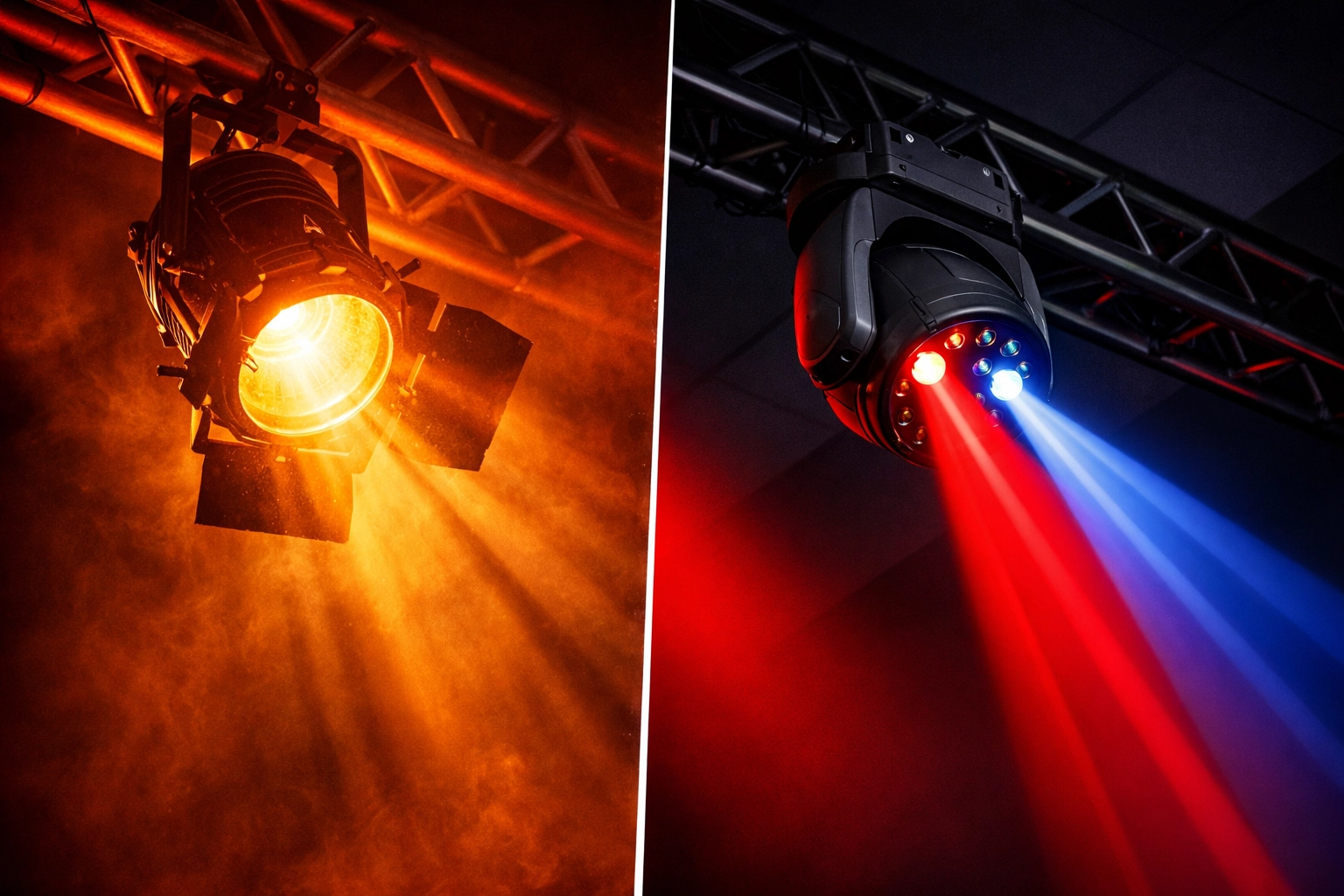
Traditional halogen fixtures pull between 300-2,400 watts depending on size. Your LED fixtures? 50-600 watts for the same output. That's a 70-90% reduction in electricity consumption.
Let's get specific. Running a traditional 750-watt Source Four costs about $0.13 per day (8 hours of use). An equivalent LED fixture? Around $0.03 per day. Doesn't sound like much, right?
Multiply that by 90 fixtures over a year. You're saving roughly $985 annually in electricity alone. Over five years, that's nearly $5,000: and that's assuming energy costs don't go up (spoiler alert: they will).
2. You Stop Buying Lamps Every Few Months
Here's the hidden cost nobody talks about: lamp replacement. Traditional halogen lamps last 200-2,000 hours depending on the type. Sometimes is less if improperly installed. If you're running services twice a week plus rehearsals and special events, you're looking at replacing lamps every 6-12 months.
Each HPL lamp runs $20-40. For a 90-fixture system, that's $1,800-$3,600 annually just keeping lamps stocked.
LEDs last 30,000-100,000 hours. You're not replacing anything for years. In most church environments, you're looking at 10-15 years before those LEDs even think about dimming.
3. Your HVAC System Gets a Break
Here's something most people miss: those old halogen fixtures generate massive heat. A 750-watt Source Four is basically a space heater pointed at your stage. In summer, your air conditioning is working overtime to compensate.
LEDs produce a fraction of the heat. Your HVAC system doesn't have to fight against your lighting rig anymore. For larger sanctuaries, this can mean hundreds of dollars in additional annual savings.
4. Labor Costs Drop to Nearly Zero
Changing lamps isn't free. Someone's got to climb the ladder (or call in a lift), swap out the lamp, refocus the fixture, and do it all over again in six months. If you're paying techs or contractors to do this, those labor costs add up fast.
With LEDs, you're doing maintenance maybe once every few years instead of multiple times annually.
The Reborn Series: The Budget-Friendly Middle Ground
Here's where this gets interesting for churches with existing ETC Source Four fixtures. You don't necessarily have to replace everything.
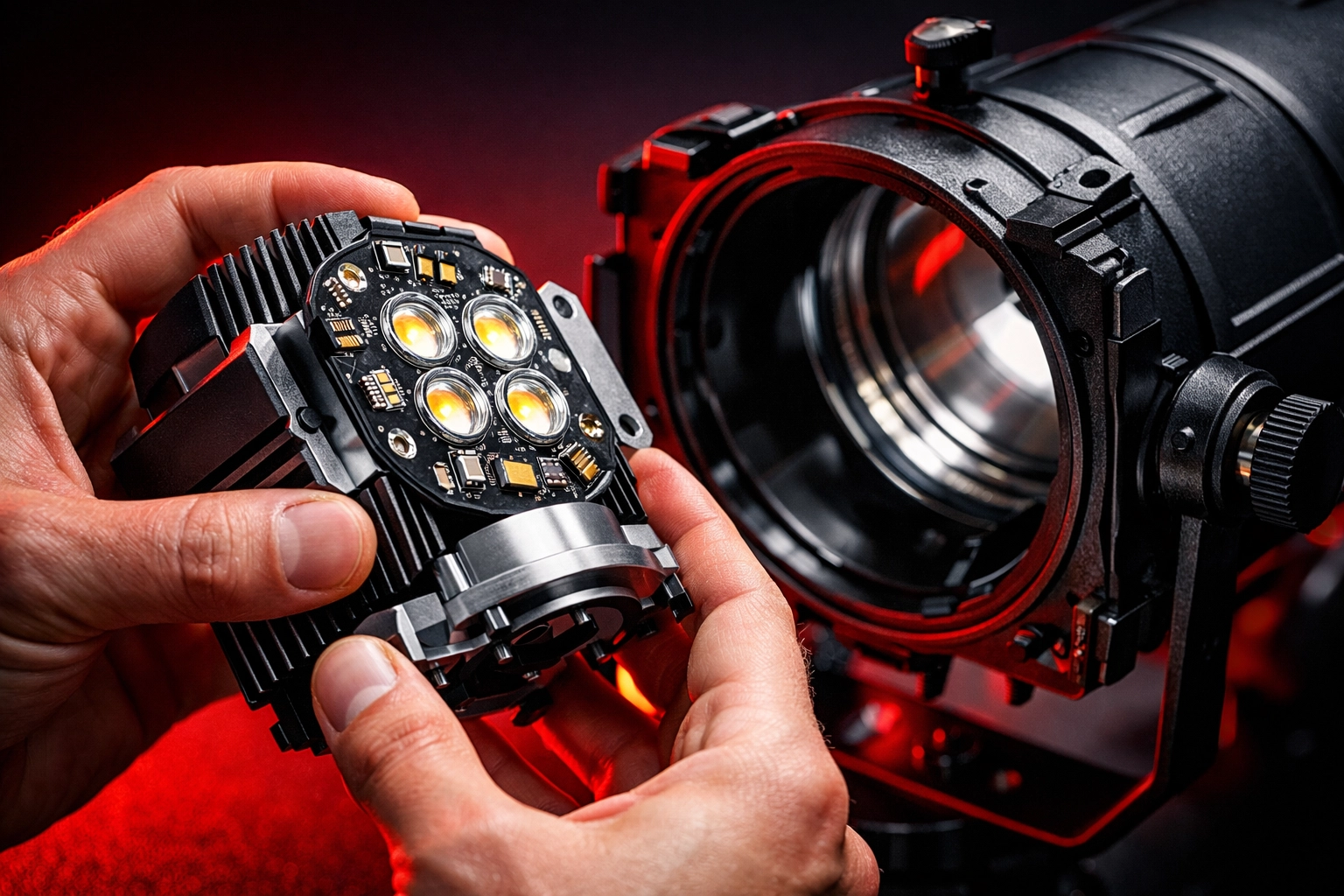
The SM Lights Reborn Series lets you retrofit your existing ETC Source 4 Ellipsoidals with LED engines. Same fixture body. Same lenses. Same shutter and gobos. Just swap the guts and you've got a modern LED fixture.
This is a game-changer if you've already invested in quality ETC ellipsoidals and don't want to throw them away. You get:
- Full LED power efficiency (about 200 watts vs. 750 watts)
- 50,000+ hour lifespan
- Flicker-free output for livestreaming and broadcast (more on this in a second)
- Compatibility with all your existing ETC Source Four accessories
You're essentially getting a new LED fixture for half the cost of buying one from scratch. And you're not creating a landfill full of old fixtures.
The Livestream Factor (This Actually Matters Now)
A decade ago, nobody cared if stage lights flickered on camera because nobody was putting cameras in the sanctuary. Today? Every church is livestreaming.
Traditional incandescent fixtures can create flicker on camera depending on your camera's shutter speed and the dimmer settings. It's subtle to the naked eye but looks terrible on video: especially if you're dimming lights during worship.
Professional LED fixtures with proper drivers eliminate this problem entirely. SM Lights fixtures are specifically designed to be flicker-free, which means your livestream looks as good as your in-person service.
This is also why "cheap Amazon LED fixtures" are a terrible idea. They'll save you money upfront, but they'll flicker on camera, produce inconsistent color, and fail within a year or two. Then you're replacing them and spending twice.
When Traditional Fixtures Still Make Sense
Look, I'm not going to pretend LEDs are the right choice for literally everyone. There are scenarios where sticking with traditional fixtures makes financial sense:
- You operate infrequently: if your venue is only used a few times a month, the energy and maintenance savings won't add up fast enough to justify the LED investment
- You need minimal capital investment right now: if cash flow is tight and you need lights today, a few hundred dollars beats a few thousand
- You're planning a major renovation soon: if your building is getting gutted in two years, buying expensive LED fixtures you might replace anyway doesn't make sense
But for most active churches running multiple services, rehearsals, and events every week, the math favors LED within the first 1-3 years.
The Real Question: Can You Afford NOT to Switch?
Here's how to think about this decision: calculate your total cost of ownership over five years.
Traditional Fixtures (90-fixture system):
- Initial cost: ~$10,000-$30,000
- Annual electricity: ~$2,300
- Annual lamp replacement: ~$2,500
- Labor for maintenance: $500-$1,000 annually
- Five-year total: ~$25,000-$50,000
LED Fixtures (90-fixture system):
- Initial cost: ~$30,000-$60,000
- Annual electricity: ~$600
- Annual maintenance: ~$200 (minimal)
- Five-year total: ~$34,000-$64,000
The gap narrows significantly. And after year five? LEDs keep saving you money while traditional fixtures keep costing.
If you're considering the retrofit route with something like the Reborn Series, those numbers shift even more in LED's favor since your upfront cost drops by 30-50%.
Making the Switch Without Breaking the Budget
You don't have to replace everything overnight. Here's the smart approach:
Phase your upgrade. Start with your most-used fixtures: typically front wash positions that run every service. Replace those with LEDs or retrofit them with Reborn Series engines. You'll see immediate savings on the fixtures you use most while spreading out the capital investment.
Check for utility rebates. Many electric companies offer rebates for switching to LED fixtures. It's worth a phone call to see if your utility has any programs that could offset 10-20% of your costs.
Consider timing. If you're already doing HVAC work, electrical upgrades, or building maintenance, rolling lighting upgrades into the same project can reduce installation labor costs.
The Bottom Line
LEDs cost more today and save more tomorrow. Traditional fixtures cost less today and keep costing more every month you use them.
For active churches with regular services, livestreaming needs, and long-term facility plans, professional-grade LED fixtures pay for themselves within 1-3 years. After that, you're pocketing thousands in savings while dealing with virtually zero maintenance headaches.
The Reborn Series gives you a middle ground: modernize what you have without starting from scratch.
And honestly? If your tech director is already frustrated with changing lamps every few months or your livestream has flickering issues, you're past the point of debating. You need LEDs. The only question is how fast you can make it happen.
Ready to talk specifics about your lighting upgrade? We're here to help you figure out what makes sense for your space, your team, and your budget. Check out our full range of professional stage lighting or reach out to our team: we've helped hundreds of churches make this transition without blowing their budgets.