
How to Choose LED Stage Lights That Actually Last: The Church Tech Director's Buying Checklist
![[HERO] How to Choose LED Stage Lights That Actually Last: The Church Tech Director's Buying Checklist](https://cdn.marblism.com/gu0vX0W3zxk.webp)
So you've got budget approval to upgrade your stage lighting. Amazing! Now comes the hard part: actually choosing fixtures that won't die on you three years from now or start flickering during your livestream.
Here's the reality check: not all LED stage lights are created equal. Some will serve your church faithfully for a decade or more. Others will burn out, flicker, or fall apart before you've even paid off the credit card.
After 17+ years in this industry at SM Lights, we've seen what separates the workhorses from the duds. Let's break down exactly what to look for so you don't end up with a storage closet full of expensive paperweights.
Start With the Lifespan Rating (But Don't Stop There)
First things first: check the rated lifespan. Quality LED fixtures should be rated for at least 20,000 to 50,000 hours of operation. That's the baseline. If a manufacturer won't tell you the lifespan rating, that's your first red flag.
But here's what most people don't know: the headline number only tells part of the story. You also need to ask about the light decay rate, which measures how much brightness the fixture loses over time.
Think about it this way: a fixture rated for 50,000 hours sounds great, until you realize it's only putting out 60% of its original brightness after year three. You'll end up replacing it anyway because your stage looks dim and muddy on camera.
Quality fixtures maintain their brightness better over the long haul. They might cost more upfront, but they actually deliver the performance you need for their entire rated lifespan.
Build Quality Matters More Than You Think
Let's be honest: church lighting takes a beating. Volunteers move it for special events, road cases get dropped during Christmas setup, and fixtures spend years mounted in dusty, temperature-swinging environments.
This is where construction materials become critical.
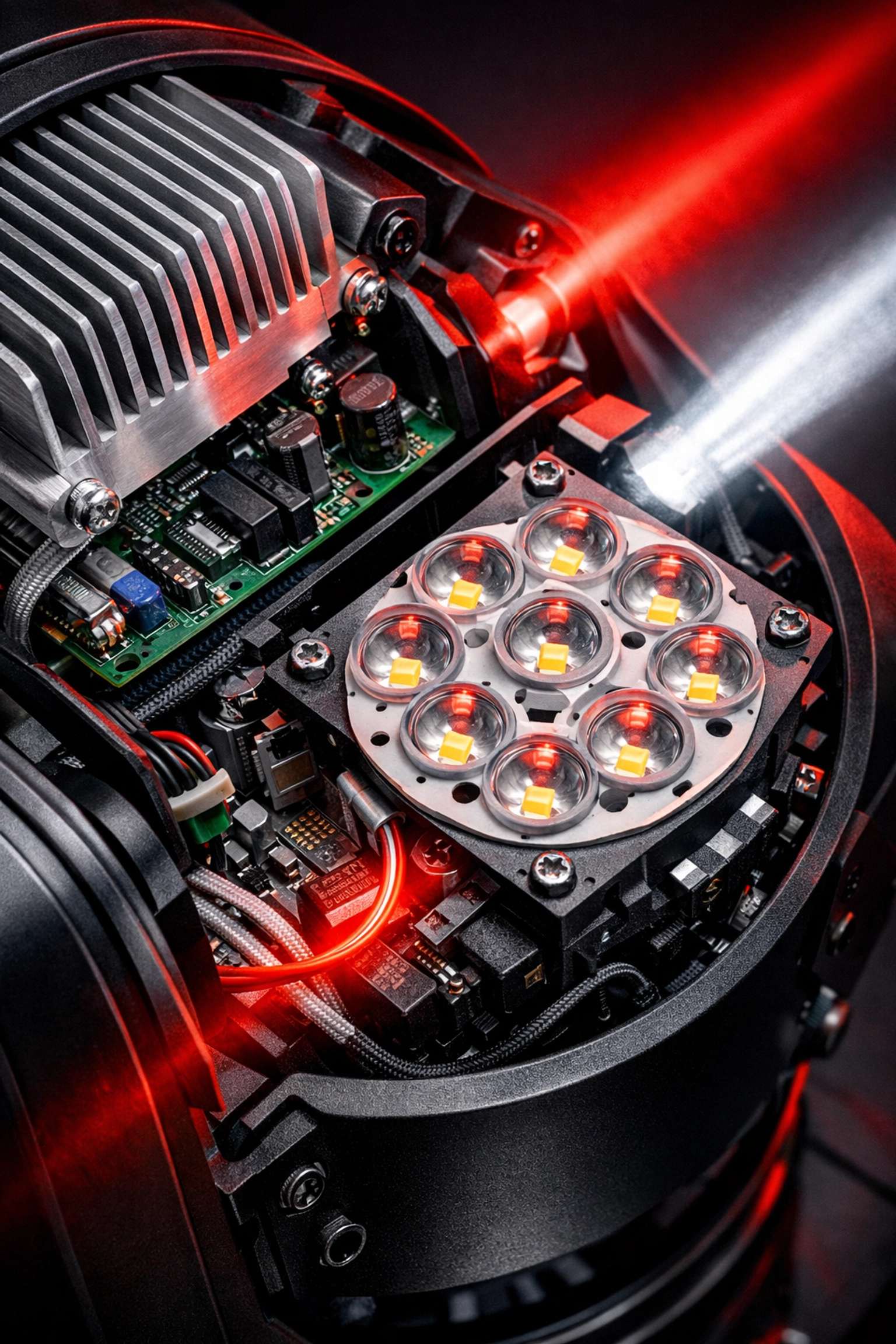
Look for fixtures with aluminum alloy bodies: not thin sheet metal or plastic housings. Moving heads especially need robust construction because they're constantly in motion and more vulnerable to impact damage during transport and setup.
Pay attention to these build quality indicators:
- Weight – Quality fixtures feel substantial, not flimsy
- Finish – Look for durable powder coating that resists scratches and corrosion
- Connection points – Yokes, mounting brackets, and pan/tilt mechanisms should feel solid
- Access panels – Well-designed fixtures make maintenance possible without disassembly
Take our Super Scope II moving heads, for example. The aluminum construction means they can handle the weekly setup/teardown cycle that many church worship spaces require. They're built to last in real-world environments, not just controlled theater settings.
Flicker-Free Performance Isn't Optional Anymore
Here's a factor that didn't matter much a decade ago but is absolutely critical now: flicker-free operation for broadcast and livestream.
If your church streams services online (and let's be honest, most of them do), fixtures that flicker on camera will make your production look amateurish. Worse, some cheaper LEDs create visible banding or strobing effects that can actually trigger headaches or discomfort for viewers with light sensitivity.
Quality LED fixtures use proper PWM (Pulse Width Modulation) dimming at high frequencies: usually 1,200 Hz or higher: that's completely invisible to cameras. Cheaper fixtures? They cut corners here, and it shows up immediately in your video feed.
When evaluating fixtures, specifically ask:
- What's the PWM frequency for dimming?
- Are they rated for broadcast/film use?
- Can they maintain flicker-free operation at all dimming levels?
Our TX1940 fixtures were specifically engineered with broadcast environments in mind. They deliver clean, flicker-free output whether you're at 5% or 100% intensity: crucial for churches running multiple camera feeds during services.
Thermal Management Keeps Everything Running
Here's something most people don't think about until it's too late: how the fixture manages heat.
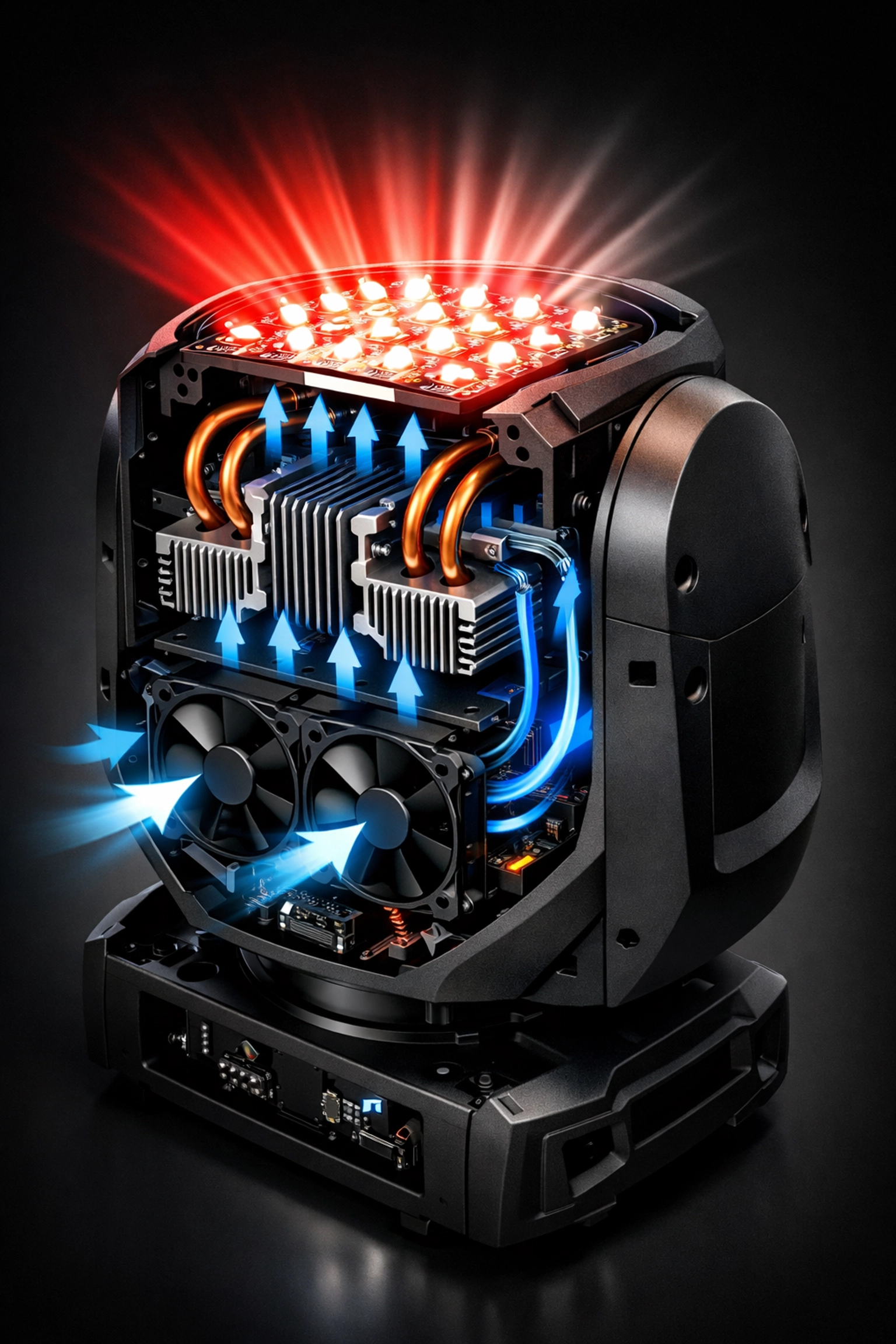
LEDs are efficient, but they still generate heat. Without proper thermal management, that heat builds up, shortens LED lifespan, and can cause color shifting or complete failure.
Quality fixtures use one of two approaches:
Passive cooling uses carefully designed heat sinks and natural airflow. It's silent but requires larger fixtures with more surface area. Great for smaller venues where fan noise is a concern.
Active cooling uses fans to move air across the LEDs and drivers. It's more compact and handles higher output fixtures, but you need to consider the noise level and the fact that fans themselves can eventually fail.
Either approach works fine: the key is that the manufacturer has clearly engineered a thermal solution rather than just cramming LEDs into a housing and hoping for the best.
Red flags to watch for:
- Fixtures that get extremely hot to the touch during normal operation
- No visible heat management design (vents, fins, or fan ports)
- Vague or missing specs on operating temperature ranges
- No mention of thermal protection features
US-Based Support Is Worth Its Weight in Gold
You know what's worse than a fixture failing? A fixture failing and having zero way to get help.
This is where buying from an established US-based company like SM Lights makes a massive difference. When you call us, you talk to an actual person in Arkansas who understands church lighting and can troubleshoot your issue right then.
Compare that to buying from an overseas wholesaler where:
- Support emails take 48 hours to get a response
- Time zones make phone calls nearly impossible
- Language barriers complicate technical troubleshooting
- Warranty claims require shipping fixtures internationally
- Replacement parts take weeks or months to arrive
For churches with volunteer-run tech teams, accessible support isn't a luxury: it's essential. Your volunteers need to be able to get help quickly when something goes wrong on a Wednesday night before weekend services.
We've been doing this for over 17 years because we know that great fixtures are only half the equation. The other half is being there when you need us.
Look for Fixtures Designed for Church Environments
Generic stage lighting can work in churches, but fixtures specifically designed with worship spaces in mind make life so much easier for tech directors and volunteers.
What does "church-ready" actually mean?
Beam characteristics – Fixtures like our PL1925 LED panel offer soft, even washes perfect for front lighting faces without harsh shadows. That's critical for livestream clarity where you need broadcast-quality facial lighting.
Color rendering – High CRI (Color Rendering Index) ratings mean skin tones look natural on camera, not sickly or off-color. Look for CRI ratings of 90 or above for worship environments.
Programming simplicity – Fixtures that offer both DMX control and stand-alone operation give your team flexibility. Not every volunteer knows how to program a lighting console, but they can still create great looks with fixtures that have built-in programs and sound activation.
Quiet operation – Critical during quieter worship moments or spoken messages. Moving heads with near-silent motors and efficient cooling make a real difference.
The PL1925 fixtures we offer check all these boxes. They're powerful enough for large worship spaces but designed with the practical needs of church tech teams in mind.
Think Total Cost of Ownership, Not Just Purchase Price
Here's where buying quality fixtures really pays off: the math changes dramatically when you look at total cost over 5-10 years.
Cheaper fixtures might save you 30-40% on the initial purchase, but consider what happens over time:
- Energy costs – Quality LEDs consume up to 80% less power than traditional fixtures, and they're more efficient than cheap LEDs too
- Replacement costs – Fixtures that last 10 years instead of 3 save you from buying replacements
- Labor costs – Less maintenance and fewer failures mean less volunteer time spent troubleshooting
- Consistency – Not having to mix old and new fixtures means your lighting looks cohesive
When you factor in all these elements, spending more upfront for fixtures that actually last becomes the financially smart decision.
Your Church Lighting Checklist
Before you buy, make sure you can answer yes to these questions:
✓ Is the fixture rated for at least 30,000+ hours with documented light decay rates?
✓ Does it have aluminum or metal alloy construction, not plastic?
✓ Is it explicitly rated as flicker-free for broadcast/camera use?
✓ Can I clearly see the thermal management design (heat sinks, vents, or quality fans)?
✓ Does the manufacturer offer US-based phone support and reasonable warranty terms?
✓ Are replacement parts and accessories actually available if needed?
✓ Do the beam characteristics and CRI ratings work for worship lighting?
✓ Does the price reflect quality construction, or am I just paying for fancy features I don't need?
If you can't get clear answers to these questions from a manufacturer or dealer, that's a sign to keep looking.
We're Here to Help You Choose Right
Choosing lighting that actually lasts doesn't have to be overwhelming. You just need to know what questions to ask and which specs actually matter.
Our team at SM Lights has been helping churches navigate these decisions for over 17 years. Whether you're looking at our Super Scope II moving heads, PL1925 LED panels, TX1940 fixtures, or other professional stage lighting options, we can talk through your specific situation and recommend fixtures that fit your space, team, and budget.
Give us a call or reach out through our support page. We're not here to just sell you something: we're here to make sure you get fixtures that serve your church well for years to come.